Is emergency stored water bad? How to start a rolling stock with the water you drink every day

Even if you want to prepare water for emergencies,
“Is emergency water different from the water I usually drink?”
“I’m worried about the taste of long-term storage water.”
“If I buy it, it’ll probably just sit there.”
“Before I know it, the best-before date will have passed.”
Have you had any of these experiences or concerns?
When living in Thailand, heavy rain, floods, water outages, power outages, and delivery delays can make it difficult to buy water as usual.
That doesn’t mean you need to buy a large amount of water just for emergencies and store it for years.
An easy method to adopt is
“rolling stock,” where you keep a little extra of the water you usually drink and replenish what you use.
This is another option for households that consume a certain amount of water every month.
Instead of “buying water only for emergencies,”
drink it every day → receive new water → drink the older water first → keep a certain amount in reserve
This approach creates a continuous cycle.
This article explains how to maintain a rolling stock of water without overdoing it while living in Thailand, including how it differs from emergency water, how to use 500ml and 2L bottles, and how to combine it with regular delivery.
Is it true that “emergency water tastes bad”?
Some people may have the impression that
“emergency water tastes bad.”
However,it doesn’t necessarily taste bad just because it’s for emergency or long-term storage.
The taste and mouthfeel of water vary depending on its source, mineral composition, hardness, and other factors.
Also, the term “emergency water” may give the impression that it has been
- stored for a long time
- is only drunk in emergencies
- is not what you’re used to drinking
- was chosen solely for its shelf life
and other reasons.
In other words, the problem may not be that
“emergency water tastes bad,” but rather that “you’re storing water you don’t usually drink solely for emergencies.”
This is something to consider.
Therefore, you should consider
using the water you usually drink for emergencies as well
as well.

The “buy it and forget it” problem with emergency water
When you prepare emergency water,
you may think, “Now I’m safe,”
and leave it stored away.
However, if you leave it stored for a long time,
- you may forget to check the best-before date
- forget where you put it
- not know how many bottles are left
- have family members who don’t usually drink it
- forget when it needs to be replaced
and other problems may occur.
The purpose of preparing water is
not “to buy water,” but “to have water available when you need it.”
Therefore, you can change your approach from “storing it and forgetting about it” to “preparing it while using it regularly.”
This is rolling stock.
What is rolling stock?
Rolling stock is a method of emergency preparation where you
keep a little extra of what you use regularly and maintain a certain amount by replenishing what you use.
This is how it works with water:
Buy a little extra
↓
Drink it regularly
↓
Replenish what you use
↓
Drink the older water first
↓
Always keep a certain amount at home
This is the process.
Instead of storing water exclusively for emergencies for a long time,
the key is to use it as both “daily drinking water” and “emergency preparedness.”
This is the main point.

Four benefits of keeping water in a rolling stock
1. You can keep water you’re used to drinking
You don’t need to switch to a different kind of water just because it’s an emergency.
If you keep a little extra of the water you drink regularly, you can drink the same water in an emergency.
2. It’s easier to prevent the best-before date from passing
Instead of leaving it stored for emergencies, you drink and replace it regularly, making it easier to prevent older water from sitting around.
The key is to
drink the older water first and put the newly purchased water at the back.
This is the “first in, first out” principle applied at home.
3. You can start without buying a large amount just for emergencies
If you think, “I have to buy a large amount of water for disaster preparedness,”
it can be difficult to get started.
With rolling stock,
you can start by keeping a little extra of the amount you usually buy.
4. It’s not wasted even in everyday life, not just in emergencies
Since you drink the stored water regularly, it won’t go to waste even if an emergency doesn’t occur.
The key to making rolling stock easier to maintain is not to separate your daily life and emergency preparedness too much.

Long-term storage water or rolling stock: which is better?
This is
not a matter of one being better than the other.
They serve different purposes.
Long-term storage water
This is water prepared with long-term storage in mind.
Because it doesn’t need to be replaced frequently, it’s convenient to keep as emergency water.
On the other hand, if you don’t drink it regularly, you need to make sure you don’t forget to check the best-before date and storage location.
Rolling stock
This is a method where you keep a little extra of the water you usually drink and replenish what you use.
It’s an easy method to adopt for households that consume water regularly.
However,
it has the weakness that your emergency supply will decrease if you don’t replenish it.
In other words,
long-term storage water = preparedness for long-term storage
rolling stock = preparedness that circulates within your daily life
This is an easy way to think about it.
You can also combine both methods.

The most important point of rolling stock is “replenishment”
Rolling stock
is not something you buy and forget.
When you drink it, replenish it.
You need to keep doing this.
However, in real life,
“I meant to buy it later, but I forgot,”
“Before I knew it, I was down to the last bottle,”
“I was too busy to go buy a case,”
“I forgot to order it,”
and other things can happen.
In other words, what’s surprisingly difficult about rolling stock is
not storing it, but continuing to replenish it.
This is the point.
Therefore, for households that drink a certain amount of water every month, there is the option of regular delivery.
The idea of “regular delivery × rolling stock”
Regular delivery and rolling stock are a good combination.
With rolling stock,
you need to drink → use up → buy more
This is the process.
By using regular delivery,
you can change it to drink → use up → receive regularly
This is the system.
In other words,
it changes from “trying hard not to forget to buy it” to “creating a system that replenishes it.”
This is a major benefit of using regular delivery for rolling stock.
The basics of rolling stock using regular delivery
The idea is simple.
For example, if you receive a certain amount of water every month,
STEP 1|Keep a little extra at home
First, make sure you have a certain amount left in addition to what you drink regularly.
↓
STEP 2|Drink the older water first in your daily life
Use it for daily hydration, work, outings, meals, exercise, and other activities.
↓
STEP 3|Receive new water through regular delivery
Instead of ordering every time, receive new water regularly.
↓
STEP 4|Put the newly arrived water in the reserve
Drink the older water first and use the newly arrived water later.
↓
STEP 5|Keep a certain amount as much as possible
Continue this cycle.
The idea is,
drink → receive → put at the back → drink the older water first → receive again
This is the process.
This way, you can combine daily hydration and emergency preparedness into a single flow.
Does regular delivery automatically become rolling stock?
You need to be careful here.
Just having regular delivery doesn’t necessarily make it rolling stock.
For example,
You receive 30 bottles every month.
↓
You drink all 30 bottles every month.
↓
You have 0 bottles left just before the next delivery.
If that’s the case, even if you have regular delivery for daily use, you’ll have almost no reserve for emergencies.
If you want to use it as rolling stock,
you need to consider “the amount you drink regularly + the amount you keep in reserve.”
This is important.
The key is to create a system where a certain amount is always left at home.
This is the difference between regular delivery and regular delivery with rolling stock in mind.
Set your own “minimum stock level”
One way to make rolling stock easier to manage is
to set a line that you “will not let it fall below.”
This is the point.
For example,
“Keep one unopened case,”
“Make sure it doesn’t fall below ○ bottles,”
and other rules that work for your household.
The amount you need to keep in reserve depends on
- family size
- living environment
- storage space
- regular consumption
- how many days’ worth you want to keep in reserve for emergencies
and other factors.
For more details on how many days’ worth and how many liters to keep in reserve,“How many days’ worth of drinking water do you need to prepare for power outages and floods in Thailand? A guide by family size”explains it in detail.
500ml or 2L: which is better for rolling stock?
You don’t need to choose one or the other.
Because they serve different purposes, you can combine them.
2L|For household stock
2L bottles are
- drinking with the family
- meals
- tea and coffee
- daily hydration at home
an easy size to use for these purposes.
They are well suited for storing while consuming them regularly at home.
500ml|For taking out or personal use
500ml bottles are
- commuting
- outings
- cars
- gyms
- golf
- guests
- emergency carry-out
an easy size to use for these purposes.
Because they can be used by one person as is, they are also easy to share in an emergency.
You can use 2L bottles at home.
And 500ml bottles for outings and taking out.
This is a good way to combine them.
Why consider rolling stock while living in Thailand
When thinking about preparedness in Thailand, you don’t need to consider only large-scale disasters.
For example,
- heavy rain making it difficult to go out
- floods making it difficult to travel
- water outages
- power outages
- delivery delays
- traffic jams and transportation disruptions
and other situations where you may not be able to buy water as usual.
In such times,
having a little extra of the water you usually drink
at home can be helpful.
Rolling stock is
not “preparedness only for an unpredictable major disaster,”
but
can also be thought of as preparedness to make your daily life a little less disruptive.
This is another way to think about it.
In Thai condominiums, you also need to be careful not to store too much
In condominiums in Bangkok and other areas, storage space may be limited.
That doesn’t mean you need to store as much water as possible.
Use areas around the kitchen.
Storage shelves.
The lower shelves of a closet.
The entryway storage area.
Use spaces that do not interfere with your daily life.
The important thing is
not only the amount, but also that it is manageable.
Consider the amount you need and choose a method that suits the space in your home.
What is the difference between “daily stock” and “rolling stock”?
They are similar, but their purposes differ slightly.
Daily stock
The purpose is
to ensure you do not run out of water in your daily life.
It is used for drinking, outings, cooking, guests, and other purposes.
For more information on daily water stock in Thai households,“How much drinking water should you keep on hand while living in Thailand? A guide to water storage methods for Japanese households”please see this article.
Rolling stock
The purpose is
to maintain a certain amount that can be used in emergencies while using it regularly.
In other words,
daily stock + emergency preparedness
This is the approach.
The water you keep in a rolling stock should be “water you want to drink regularly”
Rolling stock is based on the premise that you consume it regularly.
That is why
it is not “anything will do as long as you can drink it in an emergency,”
but
“whether it is water you would want to drink regularly”
is also important.
The taste and mouthfeel of water vary depending on its source, hardness, mineral composition, and other factors.
Some people prefer hard water, while others prefer soft water.
Neither is absolutely better than the other as emergency water.
With rolling stock,
choosing water that your family can drink comfortably every day
is the key to making it work.
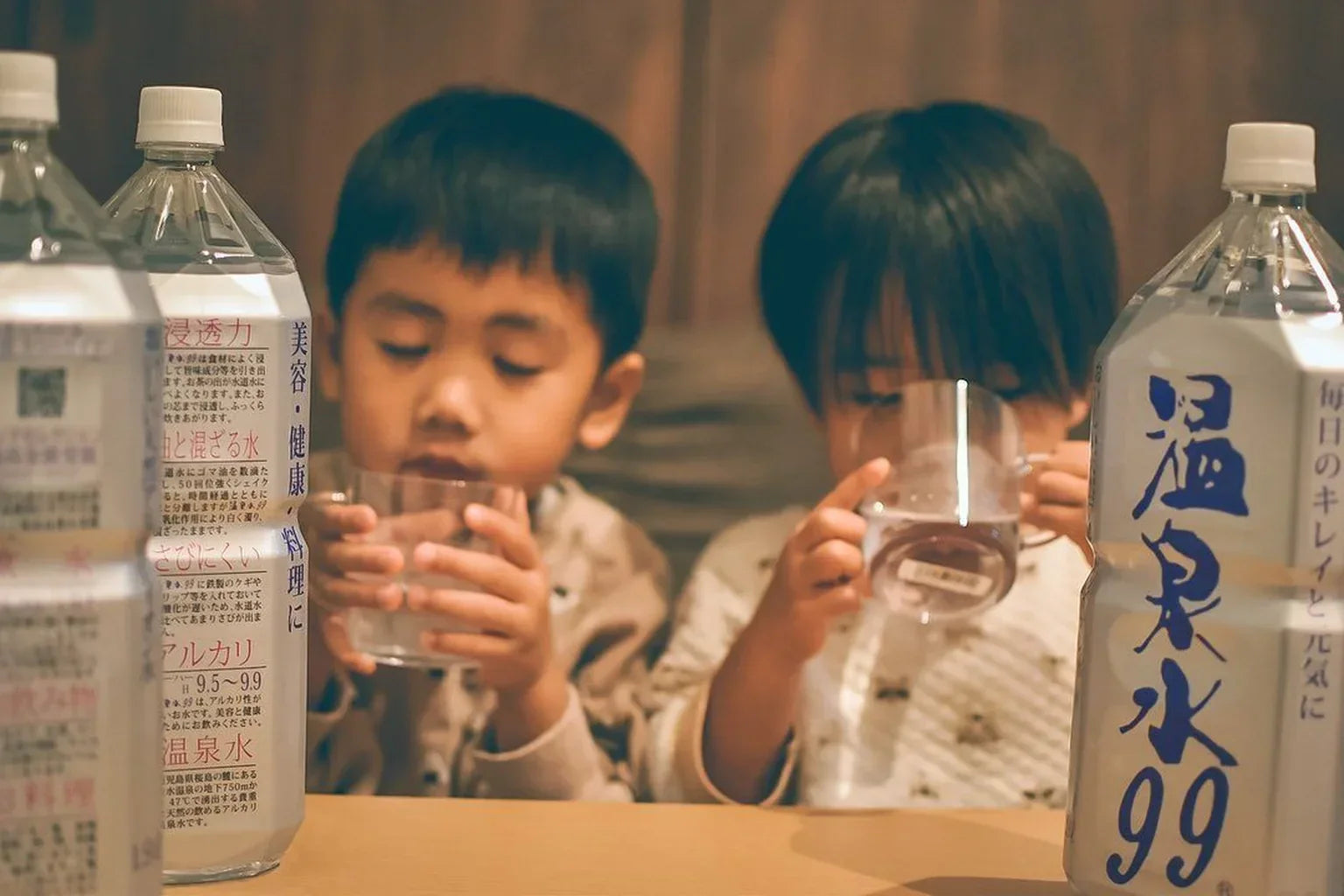
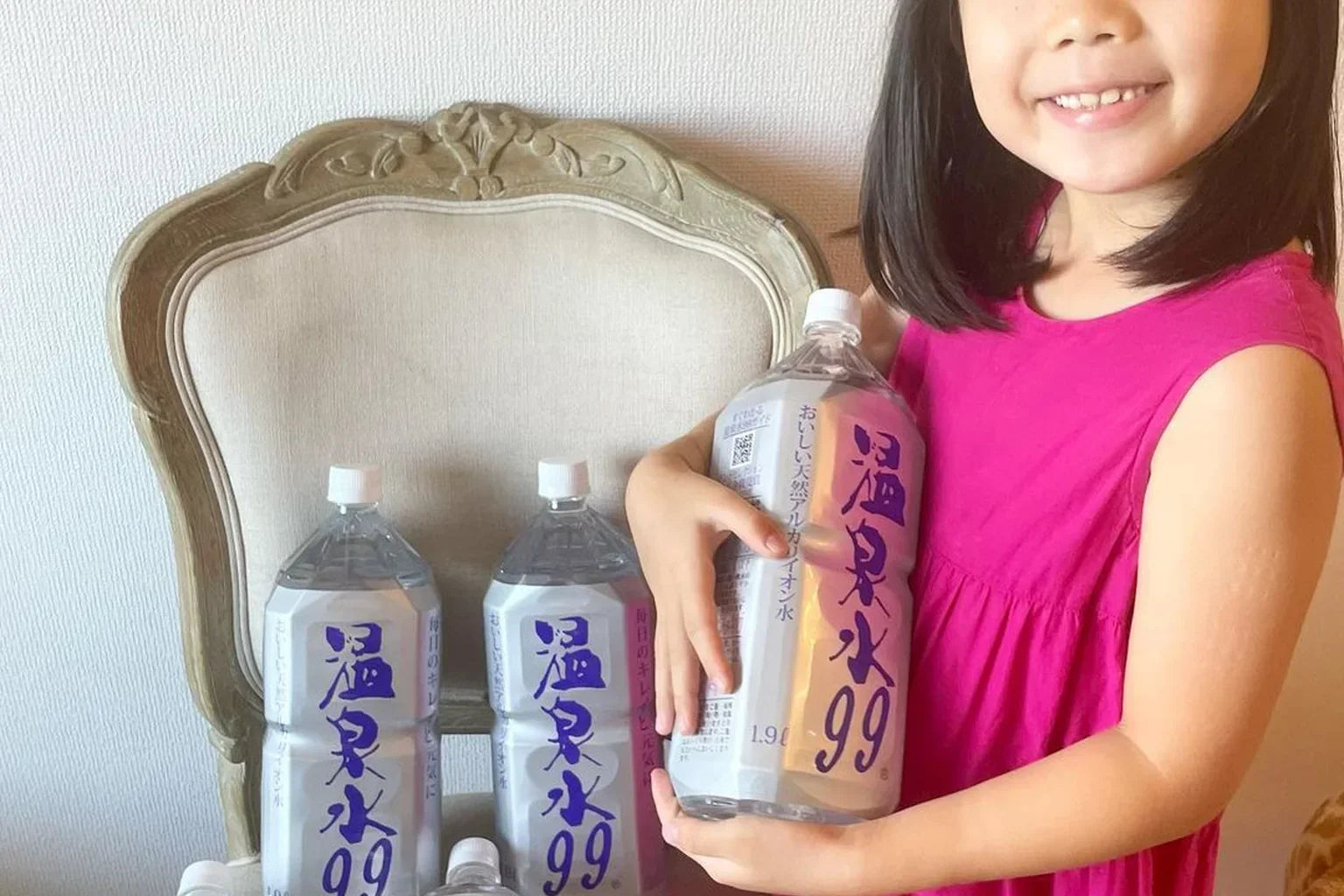
Make ONSENSUI99 your “drinking water + emergency preparedness water”
ONSENSUI99 (Onsen Water 99) is natural hot spring water collected from about 750m underground in Tarumizu City, Kagoshima Prefecture.
One of its features is
its very low hardness of 1.7mg/L
We describe it as “ultra-soft water.”
It has a soft, smooth mouthfeel and can be incorporated into your daily drinking routine.
Furthermore,
it has a natural pH of 9.5–9.9
This is a characteristic of the water.
It has not been artificially adjusted to be alkaline.
However,
this does not mean
“it is suitable for emergency water because its pH is high.”
What is important for rolling stock is
that you can drink it regularly, continue to replenish it, and maintain a certain amount.
For households that regularly drink ONSENSUI99,
you can incorporate it into a rolling stock system by not completely separating everyday water from emergency water, but rather “keeping a little extra of the water you normally drink.”
For more information about ONSENSUI99, please see
“What Is ONSENSUI99? The Appeal of Natural Hot Spring Water Nurtured in Tarumizu City, Kagoshima Prefecture.”.ONSENSUI99 Subscriptions and Rolling Stock
When using ONSENSUI99 as your daily drinking water,
you can use a subscription as a way to replenish your rolling stock.
For example, you can use 500ml bottles for
morning hydration,
work,
going out,
the gym,
golf,
meals,
and guests.
Then, keep a certain amount at home and drink the oldest bottles first when new products arrive.
In other words,
Drink daily
↓
Stock decreases
↓
New water arrives regularly
↓
Add new water to the stock
↓
Drink the oldest water first
is the cycle.
This way,
you don’t have to “keep ONSENSUI99 solely for emergencies,” but can instead prepare while drinking it every day.
.
A subscription can be viewed not just as “a service that delivers water every month,” but also
as a system that makes it easier to maintain a rolling stock.
.
Calculate the Subscription Amount as “Consumption + Emergency Stock”
If you use a subscription for rolling stock,
don’t just look at
how many bottles arrive each month, but also
check how many bottles you drink each month.
For example, if the amount delivered and the amount consumed are almost the same each month, your stock will not increase.
Conversely, if the delivery amount significantly exceeds your consumption, you will end up with too much water.
Therefore, it is important to
understand your normal consumption
+
decide how much you want to keep for emergencies
+
adjust the delivery frequency and quantity
.
Rolling stock is not about
“buying a lot,” but rather “maintaining a constant supply”
.
Frequently Asked Questions | Emergency Water and Rolling Stock
Q. Does emergency water really taste bad?
Just because it is for emergency use or long-term storage doesn’t mean it will necessarily taste bad.
The taste and mouthfeel of water vary depending on the water source, hardness, mineral composition, and other factors.
You may also find water that you are not accustomed to drinking “difficult to drink.”
Q. What is rolling stock?
It is a method of emergency preparation where you keep a little extra of the food and beverages you normally use and maintain a constant supply by replenishing what you use.
In the case of water, you use the water you normally drink as an emergency supply.
Q. Is long-term storage water or rolling stock recommended?
Because their purposes differ, neither is absolutely superior.
You can also combine water stored for long periods with water that you drink and replenish regularly.
Q. How many days’ worth of rolling stock do you need?
The amount you need varies depending on your family size and living environment.
For specific emergency supply amounts, please see the emergency water guide for different family sizes.
Q. Does a subscription count as rolling stock?
A subscription alone does not automatically become a rolling stock system.
You can use it as rolling stock by keeping a certain amount at home while drinking it regularly, then replenishing it with newly delivered water to maintain the cycle.
Q. Are subscriptions and rolling stock a good match?
Because subscriptions make it easier to avoid forgetting to replenish your supply, they can be one way to maintain a rolling stock system for households that consume a certain amount of water every month.
However, it is important to check the balance between consumption and delivery amounts.
Q. Should I store 500ml or 2L bottles?
They can be used for different purposes.
2L bottles are easy to use at home, while 500ml bottles are convenient for going out or carrying with you in an emergency.
You can also combine both.
Q. Can I use ONSENSUI99 as emergency water?
If you normally drink ONSENSUI99, you can incorporate it into a rolling stock system by keeping a certain amount at home and replenishing it while drinking it regularly.
Check the expiration date of the product and use the oldest bottles first.
Summary | From “Storing Water” to “Preparing While Drinking”
When you think of emergency water,
you may imagine buying → storing → keeping it until an emergency occurs.
.
However, there is another way.
That is
drinking daily → replenishing → keeping a certain amount
as a rolling stock system.
If you normally drink the water, you can use familiar water in an emergency.
By consuming it regularly, you can also make it easier to avoid leaving old water sitting around.
And one of the key aspects of rolling stock is
“replenishing what you drink,”
and a subscription is one way to systematize this.
Keep a little extra of the water you normally drink.
Drink the oldest bottles first.
Regularly replenish with new water.
Always keep a certain amount at home.
This way,
you can combine daily hydration and emergency preparation into a single cycle.
.
ONSENSUI99 is natural hot spring water from Tarumizu City, Kagoshima Prefecture, witha hardness of 1.7 mg/L, ultra-soft water, and a naturally derived pH of 9.5–9.9..
Rather than keeping it solely for emergencies,
turn the water you drink every day into emergency water.
If you are thinking about preparing water for living in Thailand, consider the “prepare while drinking” method, which combines rolling stock and a subscription.
Related Articles
- How Many Days’ Worth of Drinking Water Do You Need to Prepare for Power Outages and Floods in Thailand? A Guide for Different Family Sizes
- What Is the Best Emergency Water for Living in Thailand? A Comparison of Stored Water, Everyday Drinking Water, and Water Delivery Services
- How Much Drinking Water Should You Keep on Hand When Living in Thailand? How Japanese Households Store Water
- Is This Enough Emergency Water for Living Alone in Bangkok? A Guide to Storage Locations and the Number of Bottles
- What Is ONSENSUI99? The Appeal of Natural Hot Spring Water Nurtured in Tarumizu City, Kagoshima Prefecture